Tag: Iceland Gull

Birding Rhode Island at Christmas

Common Eider at Sachuest Point NWR, Newport, RI

Birding Rhode Island at Christmas-time

It’s a bit backwards for Californians to vacation in Rhode Island at the end of December. People who think 45 degrees is freezing have no business in a place where the high doesn’t reach 30 degrees. That said, we actually avoided a week of steady rain in LA. And I also got to see some birds I don’t usually see. Survival required 2 layers of pants, 5 layers on top, gloves and a scarf, but I saw them. 

We bookended a stay on the water in Barrington with time near Brown University in Providence. What a charming neighborhood. With the trees bare of leaves and it far too cold for most bugs, songbirds were scarce. (How do the sparrows and titmice and chickadees who stick around tolerate it?) Makes you appreciate the bird numbers we have around L.A. throughout the winter. If geese, ducks, and gulls are your jam, however, Rhode Island in December is the place to be.

Canada Geese were everywhere. Brant were abundant along the shore. The gulls included Greater Black-backed, American Herring, and Ring-billed. I found one Iceland Gull on the river in downtown Providence. It was a Kumlein’s subspecies, which are much paler than our dark Thayer’s subspecies Iceland Gulls on the west coast (those were separate species until 2017).

Duck-wise, it was a bonanza. Between ducks, scoters, and mergansers, I saw 17 species. I managed all three species of merganser. Seeing the male Common Eiders and their sloping foreheads was a delight. So, too, were the Harlequin Ducks at bitterly-cold Sachuest NWR. Harlequin Ducks like swift rivers in summer, and rocky coastlines in winter with pounding surf. Apparently, they suffer the greatest amount of broken bones of all birds. I found a pair of Barrow’s Goldeneye among the expected Common Goldeneye at Colt State Park. And I saw more American Black Ducks than I’d ever seen in my life.

Birds Besides Ducks, Geese, and Gulls

There were other birds to be found. In the water and on the coast, I added one life bird to my list: Purple Sandpiper. These shorebirds like rocky coasts, and I found a half dozen of them with a group of 20 Ruddy Turnstones on my first foray to try and find them. Always nice to get the main target bird of the trip checked off early. I also added Great Cormorant, a bird I’d seen in Spain, to my ABA life list.

Songbird wise, I stumbled on a Palm Warbler in Providence that should’ve been much farther south by now. Parks mostly hosted Blue Jays and Song Sparrows, and little else. But in one spot. I finally found some numbers and diversity. In a tangle, a tiny Winter Wren appeared next to a White-throated Sparrow. I saw one Yellow-bellied Sapsucker and three species of woodpecker. A couple of Fish Crows thankfully gave their nasal call. as they flew over. And there was a Brown Creeper, one of my favorite birds to find. I checked a few spots that might’ve had Snow Bunting, a bird I have only seen once, without any luck. 

Sachuest National Wildlife Refuge

Over 8 days, I saw 66 species (I can see that many in a single day in my 5MR in January, for comparison). Since it was a family-focused vacation, I wasn’t able to chase as much as I might’ve wished. There were some Black-headed Gulls in the south coast I would’ve liked to see. And on our last day in Rhode Island, a Pink-footed Goose was spotted on the border with Connecticut. Maybe if I wasn’t the only birder in the bunch, I would’ve squeezed it in. But you can’t see them all. 
 

Birding Ballona Creek #3 – Lincoln to Inglewood Blvd.

Birding Ballona Creek: Lincoln to Inglewood Blvd.

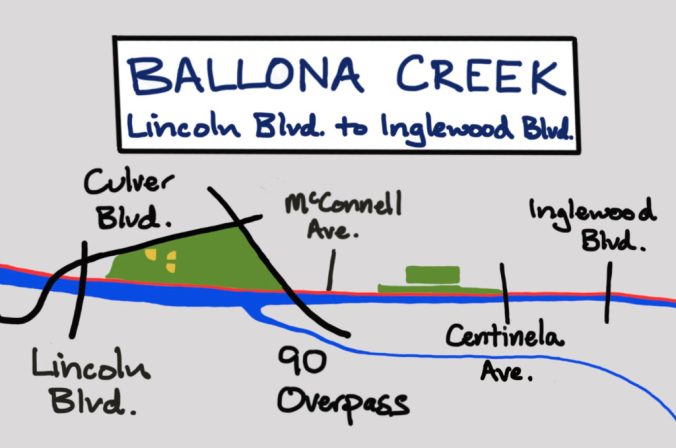
This entry in my guide to birding Ballona Creek covers the 1.6 mile-long section from Lincoln Blvd. to Inglewood Blvd. The creek remains tidal for this entire stretch, and the tide can make the difference between a wide creek with few birds and vast exposed mud and rocks with lots of birds.  The birds dwindle in number and variety as you move inland. At Centinela Ave., the creek becomes thinner, with a concrete bottom and almost no vegetation. The area is covered by three different eBird hotspots: one for Lincoln Blvd. to the 90 overpass; another for the section from the 90 overpass to Centinela Ave.; and a third covering Centinela Ave. to Inglewood Blvd. I’ve divided this post into 3 corresponding sections.

I have no idea what’s going on here

Lincoln Blvd. to the 90 Overpass

We’ll start at Lincoln Blvd., and head inland. This is the first section of creek where, at low tide, you get exposed mud in the middle of the creek. As a result, you can get decent-sized flocks of gulls and shorebirds here at a good low tide. This is especially true right near the 90 overpass, where the Centinela Creek channel joins Ballona Creek. Any time of year, 100 or more gulls are often roosting on the exposed mud. This is a good spot to see westside Herring, Glaucous-winged, and (less commonly) Short-billed Gulls for those who don’t want to spend $8 to park at Dockweiler Beach.  If I were a better birder, and patient enough, I might be able to find a rare gull in these parts, but that’s still above my birding pay grade. The best I can do is the occasional Iceland Gull. During the summer, the gulls are joined by about 100 Caspian Terns. In migration and winter, Black-bellied Plovers (plus the recently regular Pacific Golden-Plover) and Willets move in at low tide. Least and Western Sandpipers are often feeding along the creek edge. 

Occasionally, again at low tide, turnstones, Surfbirds, and Dunlin make it this far up the creek. Osprey diving for fish and Peregrine Falcons harassing the Bonaparte’s Gulls and small shorebirds have provided some entertaining bird watching here. Rarities include Cattle Egret, Wilson’s Phalarope, and Black Skimmer (almost always right near the 90 overpass). As you can see, the area just downstream of the 90 overpass is the best spot in this section of the creek.

Ballona Creek pano Lincoln

Looking north from Lincoln Blvd. to the 90 overpass at low tide

The fields north of the creek attract a few different species. In addition to sparrows and starlings and Western Meadowlarks, American Pipits can be found bobbing their rumps in the little league baseball fields in winter. I’ve been crossing my fingers for years that a Mountain Plover will show up one day, but no luck yet. Maybe the fields are too small. Kestrels, kingbirds, Loggerhead Shrike, and White-tailed Kite perch on snags out in the field. Swallows and swifts love the overpasses, with Barn Swallows and Northern Rough-winged Swallows nesting. 

Ballona creek sunset

Sunset from the Centinela Ave. bridge

90 Overpass to Centinela Ave.

This is the only section of the entire creek that is lined on both sides with vegetation. Amongst the reeds and bushes, you can find birds like Sora and Common Yellowthroat and Song Sparrow (I even saw a Virginia’s Rail here once in 2016). For some reason, the ducks like this section much better than the downstream section, so there are often a good number of Blue-winged, Cinnamon, and Green-winged Teal (depending on the season), Gadwall, Northern Shoveler, American Wigeon, Ruddy Duck, and Mallard here. Best I can tell, only Mallards breed on the creek. Greater Yellowlegs and Black-necked Stilt are the long-legged birds here, with some Dowitchers (mainly Long-billed) from time to time. Ospreys like to perch in the tall trees along the creek and can sometimes be seen diving for fish in these shallow waters. Thanks to the trees at the Milton Street Park near the Marina del Rey Middle School fields, you can find some warblers and songbirds here, too. I’ve also had Snow Goose, Egyptian Goose, and Canada Goose in the fields, and Ross’s Goose and Greater White-fronted Goose in the water. Every other January, a Common Gallinule shows up, usually close to Centinela Avenue.

Centinela Ave. to Inglewood Blvd.

The short, concrete-bottomed section between Centinela Ave. and Inglewood Blvd. (about 1/3 of a mile long) is completely devoid of creekside vegetation. It is reliable for, and rarely offers more than, Black-necked Stilts, American Coots, Crows and Mallards for most of the year.  For reasons I can’t quite explain, it’s an attractive spot for sandpipers during fall migration (September). Perhaps its tidal nature, and the shallow water, has something to do with it. I’ve had Western, Least, Semipalmated, Spotted, Baird’s and Pectoral Sandpipers here. In September, a couple of dozen Red-necked Phalaropes gather and feed as if on a conveyer belt. They’ll float down the creek feeding as they go, and when they reach the bridge at Centinela Ave., fly back up the creek to Inglewood, settle in to the water, and float back down again. Ospreys can’t dive for fish here, but they’ll sometimes be seen standing in the middle of the creek.

Access Points to Bike Path in this area

  • Lincoln Blvd. (no parking nearby)
  • McConnell Ave. (street parking; nearest spot to gull roost)
  • Milton St. Park (at Marina del Rey middle school)
  • Centinela Ave.